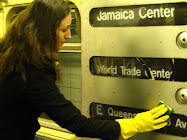
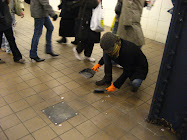
Yesterday I visited my future home and found it in a state of disarray. Without going into too much detail, it was dirty and in dire need of a Meaning Cleaning.
So I swept and vacuumed the floors, which came alive under my feet.
It was a quite realization that I can't clean everywhere else if my own house is full of dust.
Friday, May 30, 2008

Friday, May 16, 2008
Cleaning her mountains one bottle at a time
Story Highlights
Teacher in Argentina started youth group to help clean up the environment
About 150 people take part, including about 80 children
On an average Saturday, they often collect about 60 bags of trash for recycling
Llamas help carry the thousands of bottles down from the mountains
TILCARA, Argentina (CNN) -- Carmen Salva's mission may be ambitious, but her belief is simple: "It's never too early to start caring for the land you live in and grow up in." That's why on Saturdays, Salva and a group of 60 to 100 students, parents and teachers can be found venturing into the high altitude of their northern Argentina mountains, trash bags in hand and llamas in tow.
They're part of Esperanza de Vida (Hope for Life), Salva's youth environmental group that is out to clean up the surroundings, one plastic bottle at a time.
Salva, 49, was born and raised in the Jujuy province of northern Argentina, an area known for its rich culture and spectacular vistas -- "the reason why most people fall in love with it," says Salva. But despite its beauty, Salva says there's no real environmental consciousness in her community.
"We have a lot of issues to work on -- the problem of water contamination; there's so much trash," Salva says. "We can't just think that it will take care of itself." Salva, who has been a teacher in Jujuy for 20 years, says the environmental issues aren't recent ones. Ten years ago, she and her students noticed a lot of trash outside the school.
"The parks surrounding the school were littered with plastic bottles and beer bottles," recalls Salva.
They began volunteering with a government program, collecting and bagging waste in the area. But the program waned after a year, and students and teachers could no longer continue their environmental efforts. "Our city had no formal recycling program or even knowledge of why it was important to learn about fresh water, forestation, and the importance of recycling," says Salva.
So Salva began Esperanza de Vida in 1997 to organize and lead young participants in "making our streets and our environment cleaner." "I believe that change begins with the youth," says Salva. "They will teach future generations how to care for nature and everything that surrounds us."
At first, the group's activities were limited to cleaning parks near and around the school. But the organization's efforts have expanded well beyond the immediate area, and other Jujuy schools have joined in. About 150 people now take part, including about 80 children.
Salva says her students are deeply impacted by the "Pachamama" concept, or caring for Mother Earth. She and fellow teachers have noticed their students apply as much energy and commitment to the weekend environmental activities as they do to their general subjects.
"Some even wait by my house on Saturday for the program to begin," beams Salva.
The group convenes early in the morning to hike together into the mountains, where they work for hours, picking up trash and separating recyclables. Watch Salva talk about her program's impact on the students and their environment »
"We have long days and we accomplish a lot. It gets tiring because it's a lot of walking and sometimes there are cliffs," says Salva. "[But] the students enjoy it a lot. They're making changes while having fun."
On an average Saturday cleanup, it's not unusual for the group to collect roughly 60 bags of trash for recycling, clearing thousands of bottles from the mountains. The llamas help carry the heavy load down from the mountains.
"The children call them the little eco-llamas." Watch Salva discuss another way the llamas help her group in the mountains »
The local government has also pitched in, helping to provide transport of the collected recyclables to the drop-off center, located nearly 50 miles from Tilcara.
Salva says the group is making strides, raising awareness throughout her community, continually adding new volunteers, and implementing new projects. Carmen says the children are even teaching their parents to care for the environment around them. Watch Salva and her group in action in the mountains »
"It's a great joy to know that I am preparing a new generation to respect the environment," says Salva. "Their children's children will have another mentality, and [our] goal will be accomplished."
Friday, May 9, 2008
Social Sculpture and Maintenance
"Are we to assume," Mierle Laderman Ukeles has stated, " that those who dispose of trash - being all of us- are the 'garbage people'?"
Her handshakes became a social or human support structure... the people who keep the city alive as personal and anonymous. Also, how the stereotypes emerge that stigmatise certain types of work/activity.
Joseph Beuys human support via:
"...Social Sculpture--how we mold and shape the world in which we live:
SCULPTURE AS AN EVOLUTIONARY PROCESS...
All around us the fundamentals of life are crying out to be shaped, or created."
Always a little further....
Tuesday, April 22, 2008
WOW
Think we can "top" it? hee hee... Looking forward to our next above ground cleaning. This Thursday could work in the earlier part of the day... does this still work for you and maybe Carla (if she is still available?) If not, would love to start speaking on the next works and where/when they will take place. :)
Blessings,
H

Blessings,
H

Friday, April 18, 2008
E train WTC comments...
Here are some of the things said during our last cleaning performance that took place on April 17th at the World Trade Center E train station. Angela and I infused random cars as the train would pull into it's final stop and gear up to head back out again. Angela had made a good point that we should leave the passages open and anonymous so that people have the option to leave and inturn be less agressive in outcome. I quickly agreed with her insight. We decided to infuse as many cars as we could in the time of an hour as they arrived and departed.
Comments by spectator/participants:
- "Why are you doing this?"
(We are taking responsibility.)
-"Are you paid or volunteer?"
(We are artists who are volunteering to responsibly intervene in public spaces.)
_"Who do you work for?"
(We work for ourselves and the collective in the mode of collaboration. We are intervening or interrupting what is expected to be seen in the "every day" in a peaceful and hopefully postive way. Also, bringing to mind social issues of women's work, privilege, political concerns, and "art" issues.)
_ "What is that your spreading?!"
(Many people seemed very nervous by us entering the cars and getting staight to work. We were wiping all the hand rails in the car as people were entering with what appeared to be some strange liquid, while wearing bright yellow gloves, and using bright yellow sponges. Quite understandably, with "homeland security" on many people's minds, we had so many intitial reactions. Angela and I worked our best to assure people that they had nothing to worry about, that we're speading lavender essential oil. (Perhaps a priviledge we have being two white women, to be frank.) However, we are working through all the many interesting issues that these projects conjure up and addmittadly assured that the substance we are working with, "lavender," has natural antiseptic and stress relieving qualities and also has an aroma that is very unoffensive to most. Some people are adverse to the aroma, which is why we finally did decide to leave the option for choice to remain in a lavender car or go to another untreated car. Many people seemed refreshed by the time we stepped out. It was very nice to interact with everyone and is always where the most interesting part of this project comes into being.)
-"It smells so good in here!"
(We're very glad to hear this one.)
-"It smells horrible in here!"
(Respectfully, we said that the next car is lavender free.)
-"Thank you."
_"Keep up the great work."
(Thank You. Anyone can take part.)
_"How often do you do this?"
(About once a month or more...)
_"This is inspiring."
(Thanks!)
Over all it was another success. Hopefully, the cars along the line will lastingly provide enjoyment and aromatic relief for the coming days or even weeks!

Wednesday, April 16, 2008


MC tomorrow
Hayley,
It's going to be 75 degrees tomorrow...no time to be indoors mucking out the subway trains!
Want to bring our meaning cleaning above ground?
Could be interesting to use the term "spring cleaning" into our practice.
Noon is good.
Location?
Where should we clean?
Union Square may be too clean already.
Times Square? We may get arrested.
I would like to pick a place as a beginning point of departure, and do a walking cleaning, see-where-we-end-up kind of thing.
What are your thoughts on that?
Angela,
Very excited to see you and get to meaning cleaning tomorrow. Shall we meet at around noon? We could get some lunch and then start our cleaning mission on the E if that is still good for you? Then would love to head back to your studio and re-cap plus look over our future plans!
Will call you later or in the a.m. I love your last responses... Also, got the very funny feminist postcard you sent me from Queens in DECEMBER yesterday! Very funny because I also just got a postcard from a friend who was in Morocco ONE WEEK ago. Anyhow, a very belated thanks! (hee hee)
xoxo,
H
Monday, April 14, 2008
Hayley,
I'm also interested in "depressed" areas, and how neighborhoods get classified, and by whom.
This is largely because the very neighborhood I grew up in has in recent years transformed into Chelsea: artworld neighborhood of the East Coast. However, when I was a kid it was just where middle class folks like me lived because it was cheap and was close to the Village.
It wasn't exactly "cool" to live there, but it had everything one could need as a middle class family: good food shopping, theatre, parks for kids, etc. It was in close proximity to the river, which unfortunately at that time was also "depressed" (cover-up word for predominantly gay and lesbian and "other": middle to lower middle class...) It wasn't paradise, and there were many mean kids that swarmed the streets, but it was all I knew. My parents still live there, but it's a golden cage...
I'm saddened that the center middle class of New York City has largely been moved to the perimeter of the outer boroughs...makes me think of the vague comparison of District Six in Cape Town...no forced removals here, but the insidious incline of rent and cost of living has forced outward thousands of families that can no longer afford to live in Manhattan, let alone many parts of Brooklyn that have been "gentrified" or consumed by Manhattan Overflow.
...when I spoke to the CBS advertising guy about pricing for subway panels, the rates for advertising in "non-prime" (why didn't he just say 'non-rich/white/in the center' ?) areas were cut by more than half. He spoke without irony, all business.
I'd like to explore the use of panels in areas deemed undesirable. Like Women's work, much of the labor done outside the center is also under or unvalued. What could it mean to bring those aspects into the public? Who would see them? What difference could it make? How could we intervene in the space to intervene?
to continue
What is interesting about Gonzalez-Torres was that he was using a public method of communication to talk about AIDS in everyday life. The empty bed, the candy, etc. were (in my understanding of his work) about bringing awareness through his personal experience, to a crisis that encapsulated New York and the rest of the world in the early 80's - 90's.
It's interesting for you to make that connection between his work and our proposed idea about using advertising space for our work in the subway stations. I like the idea of bringing "women's work" into the public realm in much the same way, through our cleaning the subways, and potentially through using advertising space in the stations and above ground. Using very simple images perhaps of us doing the work, or other images we choose to use could be very powerful.
Perhaps we can collaborate on a proposal for the Artist in the Marketplace residency at the Bronx Museum, as well as Art in Odd Places for the Meatpacking District.
So...Thursday to infuse the train cars, and possibly clean a station. That sounds great. Time? Location? Train line? Are we still working on the E?

Throughways....
I love the billboards that Felix Gonzalez-Torres did ( I believe he was granted spaces throughout NYC via MOMA)... the images below got me thinking in response to your suggestion that we co-apply to the Bronx Museum. I also like that we could start in areas that are deamed "depressed" and think on what that means. Why are the areas "depressed?" Cleaning the cars, stations, and other throughways of this city is something that I definitely think is very worth while and I love working on it with you... it's exciting to consider also having an opportunity to clean up some "ad" spaces as well... (also something that I've wanted to do for some time! Love the "co-incidences!") Would love to adjoin this to our dialogue for prospective opportunities!
Looking forward to our performance this Thursday and then taking a look at what we need to do to go further with conversations allready started by other artists and our current situation(s) at hand (and glove) as guides. ... always a little further...
ad vert
ad join
ad junct
ad verse
A.D. ...space
These spaces belong to all of us don't they? That's what I love about Felix's work... he saw the very important issues he was dealing with (consumption, mortality, and aids...) as everyone's issue. I feel that a lot of what he did was very correct as well as beautiful and subversive.
Let's do it lady!


Tuesday, April 8, 2008
E train cleanliness
I found these images online. Making me excited about our performance this week.


I love the idea of the T-shirt as a prize for whomever helps photograph us.


I love the idea of the T-shirt as a prize for whomever helps photograph us.
open call
Another MeaningCleaning performance is slated for this Thursday or Friday in New York City...Hayley Severns and I will be infusing the E train cars with lavender oil as the train moves from station to station, beginning from the WTC station to Forest Hills, Queens and back.
The E train has recently been voted one of the dirtiest trains in the MTA, and since we started our performances on that line in January, it seemed appropriate for us to re-visit the E, take responsibility for our part in its disrepair, and perform with each other again.
We would like to document this performance in photographic form. That is the basis of this post.
If you are interested in documenting this, namely following us on the train and photographing us in a discrete and artful way as we infuse the cars, and are available on Thursday or Friday of this week from mid-day for about two hours, please contact me to schedule it. All photos will be appropriately credited.
It should be an adventure; our performances usually are.
Please email me if interested.
All my best,
Angela Rose
consciousobject@yahoo.com
Wednesday, April 2, 2008
Do you know what?
The advertising "urban panels" in subways stations, train cars, and on street level entrances are not maintained by the MTA, but have long term contracts by CBS.
I just called and spoke to an "advertising executive" who gave me rates on subway station panels in Manhattan, or the less desirable "outer boroughs"...the price is 5 times more expensive in Manhattan than it is in the other boroughs..."rock bottom" in depressed neighborhoods in the Bronx, Brooklyn and Queens.
It makes me think about applying to the Bronx Museum Artist in the Marketplace program to receive grant money to fund a subway intervention outside of Manhattan.
Hayley what do you think about this? Would you like to apply as co-applicants? I really like the idea of cleaning the subways and intervening in the space together.
Read below...
2.14.2005
VIACOM OUTDOOR AWARDED NEW YORK CITY MTA SUBWAY CONTRACT
Renewal of Agreement Includes Display Advertising on Rail Cars, In Stations and On Platforms In New York City Subways and Staten Island Railway
Ten Year Deal Also Includes 1,600 Urban Panels at Subway Station Entrances
Agreement Gives Viacom Outdoor Exposure to 1.4 Billion Subway Riders Every Year
Viacom Outdoor, the largest out of home media division in North America, today announced it has renewed its contract with the New York City Metropolitan Transportation Authority to handle all display advertising on rail cars, in stations and on station platforms in New York City Subways and Staten Island Railway. As part of the renewal, Viacom Outdoor will now get access to 1,600 urban panels, significantly increasing the division's street furniture inventory in New York City. In all, the inventory includes 6211 subway cars, 468 subway stations as well as the aforementioned urban panels.
Though specific terms of the agreement are not being disclosed, it is a 10 year deal.
"This is a huge coup for Viacom Outdoor - New York City subways are used by more than 4.6 million commuters everyday, and by 1.4 billion people annually," said Wally Kelly, Chairman and CEO, Viacom Outdoor. "Very few venues offer this kind of exposure, and even fewer companies can offer this kind of premium signage to clients. This is a hard fought win against some formidable competition in the bidding process, and we are extremely pleased to continue our relationship with the MTA. We also look forward to providing our clients signage in what is perhaps the busiest transportation system in the world.
Viacom Outdoor is the world's largest out-of-home media company with a major North American presence throughout the United States, Canada and Mexico; and across Europe in the United Kingdom, Ireland, France, Italy, the Netherlands and Spain. In 2005, Viacom Outdoor International acquired 70 percent of Magic Media, a Beijing-based company which operates media sales on?high-profile, central bus routes in the Chinese capital -- the?world's fastest growing?region in terms of outdoor advertising revenue. With both traditional outdoor and transit properties, Viacom Outdoor gives advertisers both breadth of coverage across vast geographies and depth of coverage, providing multiple media opportunities in key markets.
Wednesday, March 26, 2008
E train cleanliness

It seems our interest in the E train is shared by the local newspaper as well. amNew York had an article in it today that sparked my interest.
This may be where we go tomorrow to lavender the cars. Coincidence.
E train line
Survey: E train dirtiest in subway system
By Marlene Naanes, amNewYork Staff Writer
March 26, 2008
The E train is the most improved line when it comes to cleanliness, but it's still the dirtiest in the subway system, a survey released Tuesday said.
According to the Straphangers Campaign's ninth annual subway shmutz survey, the E train is 27 percent cleaner than it was in 2005 when only 2 percent of its cars were clean.
While the L was picked as the cleanest line, about 29 percent of E and Q train cars were clean, according to the survey, a finding that did not surprise some riders.
"The E is really the dirtiest train because when you get on it, there's usually garbage under the seats, the walls are dirty or there's puddles of stuff in there and you don't know what it is," said Brian Ballie, 18, of South Ozone Park, while waiting for the E at Penn Station. "Sometimes the smell is so bad, I just walk back out."
The survey found that 50 percent of all cars in the 22 subway lines are clean, and the entire system is slightly less grungy than it was a few years ago. L train cars ranked most tidy at 88 percent clean, according to the survey, which examined car floors and seats between September and January.
The No. 7 and 1 lines tied for the second most spic-and-span lines. The L and No. 7 trains' cleanliness was not exactly surprising since both are part of a New York City Transit cleaning initiative, the Straphangers Campaign said.
"We congratulate New York City Transit and hope that riders on the other lines will soon be seeing cleaner subway cars," said Gene Russianoff, Straphanger¹s Campaign staff attorney.
Russianoff questioned the disparities in dirt on the 22 subway lines.
"If one line can be 78 percent clean how come another line can be 29 percent clean?" he said. "You're paying the same to use the Q or the L but you're getting a much different return on your expenditure."
Transit officials said the Straphangers survey conflicted with the agency's own surveys of train cleanliness. New York City Transit found the No. 3 train was the cleanest while the M train was the dirtiest.
Officials found the entire subway was 87 percent clean.
"Providing a clean environment for our customers is one of MTA New York City Transit's top goals but our customers can help us out greatly, by properly disposing of their refuse," said Steven Feil, MTA subway senior vice president.
Tuesday, March 25, 2008
another cleaning
Hi Hayley,
Would you still like to perform another MeaningCleaning this Thursday?
I would like to.
Late morning would work for me. Lavender the E train perhaps?
Let me know,
Angela
Would you still like to perform another MeaningCleaning this Thursday?
I would like to.
Late morning would work for me. Lavender the E train perhaps?
Let me know,
Angela
Sunday, March 2, 2008
The Social Mirror, 1983

It's interesting to notice how the alteration of an everyday object has the power to transform it into a symbol that points to something other than what it is.
Ukeles' Social Mirror is inspiring in the simple way it shows us ourselves in relation to our own waste. Without the tiresome preaching of other works that come to mind.
Her work, although started in the 70's, does not feel dated to me, but actually more relevant than ever in today's throw-away mentality (I can only speak about what I witness here in New York: no caring about outside spaces, constant littering, and everyone walking over the garbage in the streets).
The piece itself was exhibited again at the Armory Show in New York by Ronald Feldman Gallery. Although I'm sure it made an impression, I don't think the context of the Armory Show was necessarily as powerful as the context of NYC streets in the 80's (considering the US economy, the social and political views of the time, etc)
The more I read about her work, the more I am inspired to follow in a similar line. I do think about the aestheticizing of public cleaning projects, but when I'm on my hands and knees the last thing that comes to mind is aesthetics.
But I do love the mirrored truck, and I do love the title.
Subscribe to:
Posts (Atom)